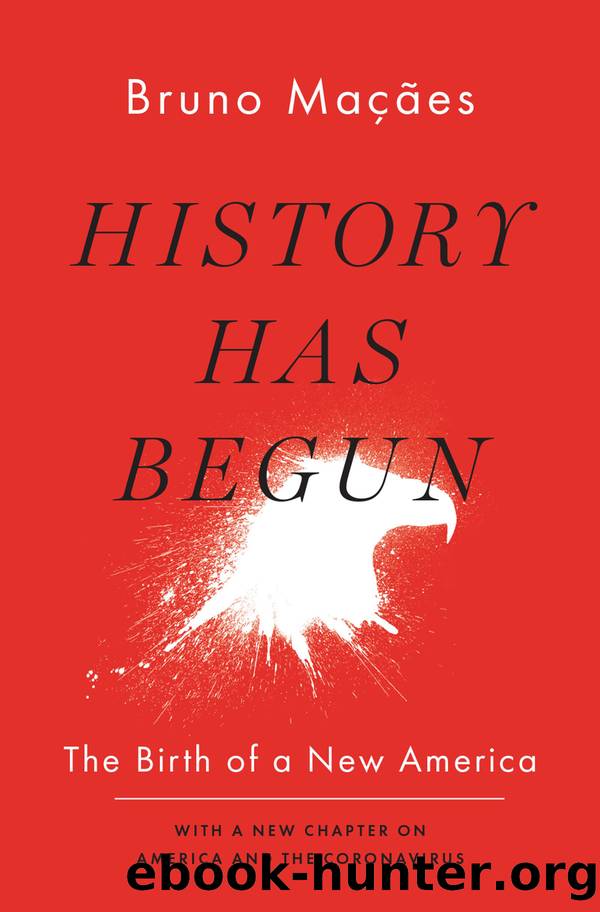
History Has Begun by Bruno Maçães
Author:Bruno Maçães
Language: eng
Format: epub
Publisher: Oxford University Press
Published: 2020-11-15T00:00:00+00:00
Six
Two decades ago, when I arrived at Harvard to study political philosophy, the discipline had become a dull affair. Imagine joining a field of study or activity after it has completed all its stated goals. Not Shakespeare, not even a commentator on his playsâyou are a commentator on his commentators. Nothing left to do, but the show must go on because there is no one in charge of pulling the plug.
It would have been bad enough if the main problems of political philosophy had already been solved. In fact it was much worse. Every problemâbig or smallâhad disappeared. There was a procedure in place, a kind of mechanism allowing us to determine what a society should look like before we knew anything about that or any other society. The procedure had been perfected by John Rawls, the greatest political thinker in American history and arguably the greatest political thinker of the twentieth century. Rawls had taught at Harvard most of his life. Austere and humourless, he struck his interlocutors as something of a religious figure: âa Puritan in a tall black hatâ, as Isaiah Berlin said. His thought towered above us, more as a prohibition than as an interrogation. There was nothing left to do. We knew the truth and were sure it was the truth. Every effort to find a new way could only be interpreted as intellectual obtuseness or, worse, moral turpitude.
While the predicament affected no more than political theorists, all might still be well. But as some of us had started to suspect, this was a more general condition. The problem was that liberalism had been so extraordinarily effective at specifying the conditions of a free society that it could produce an answer to every political question. It could produce that answer by itself, with no need to revert to the actual people living in a liberal society. Gender relations, the workplace, abortion, religion, technology, money: liberal theory could tell you how to think about each of these and many other difficult questions. You almost forgot the whole point of a free society was to let people decide important questions in their own lives. Unfortunately but unavoidably, it turned out that, by the point an individual was ready to start living, every important question would already have been decided. Not on substantive grounds but as part of a detailed specification of what needed to be the case if people were to be free to decide how they wanted to live. The paradox could drive you mad.
A story by the architect Adolf Loos seems to me to illustrate the point.1 It tells how a wealthy and happy Viennese businessman, tired of being no more than a practical man, decided one day that his life needed the exaltation and permanence of art. Or at any rateâfor whatever reasonâit needed art. He called on a renowned interior architect, who duly proceeded to throw out all his furniture and organize a small army of painters, sculptors, masons and carpenters to create a living museum.
Download
This site does not store any files on its server. We only index and link to content provided by other sites. Please contact the content providers to delete copyright contents if any and email us, we'll remove relevant links or contents immediately.
| Anthropology | Archaeology |
| Philosophy | Politics & Government |
| Social Sciences | Sociology |
| Women's Studies |
The Secret History by Donna Tartt(19466)
The Social Justice Warrior Handbook by Lisa De Pasquale(12291)
Thirteen Reasons Why by Jay Asher(9110)
This Is How You Lose Her by Junot Diaz(7054)
Weapons of Math Destruction by Cathy O'Neil(6465)
Zero to One by Peter Thiel(5945)
Beartown by Fredrik Backman(5929)
The Myth of the Strong Leader by Archie Brown(5623)
The Fire Next Time by James Baldwin(5579)
How Democracies Die by Steven Levitsky & Daniel Ziblatt(5321)
Promise Me, Dad by Joe Biden(5228)
Stone's Rules by Roger Stone(5185)
A Higher Loyalty: Truth, Lies, and Leadership by James Comey(5082)
100 Deadly Skills by Clint Emerson(5023)
Rise and Kill First by Ronen Bergman(4890)
Secrecy World by Jake Bernstein(4872)
The David Icke Guide to the Global Conspiracy (and how to end it) by David Icke(4843)
The Doomsday Machine by Daniel Ellsberg(4618)
The Farm by Tom Rob Smith(4607)
